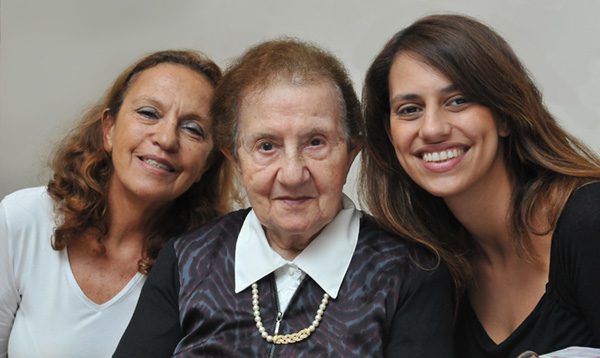

At the annual board meeting this past summer I opened the meeting asking, “Are survivors better off today than they were one year ago? Has the Claims Conference, over the past year, provided more homecare, distributed more medicine, served more meals, and paid for more hearing aids, walkers and wheel chairs for needy survivors? Have we paid out more pensions? In short, have we improved the lives of survivors?”
I took office as professional head of the Claims Conference a little over a year ago. Not a day goes by that I do not think about the fact that time is slipping away. The urgency of what we do feels like a weight bearing down on us. There is little time left to establish pensions for survivors who are currently ineligible. or to successfully convince the German government to establish a Hardship Fund for those in Eastern Europe,.. We must address homecare, medical and hunger needs of Nazi victims now, before it is too late..
Rosh Hashana, the Jewish New Year, is upon us. It is perhaps at this time more than any other that I feel the greatest weight and urgency of what we do at the Claims Conference. I sit in the synagogue and hear the words of the Untaneh Tokef prayer and my mind turns to the survivors:
On Rosh Hashanah it is inscribed,
And on the fast of Yom Kippur it is sealed.
How many shall pass away and how many shall be born,
Who shall live and who shall die,
Who in his time and who not in his time
Who by hunger and who by thirst
Who will be tranquil and who will be troubled
Who will be poor and who will be rich
Who will be degraded and who will rise
How many survivors will we help this year so they don’t know hunger again, so they can live out their last years in dignity? They of all people, those who witnessed “who by fire and who by sword and who by hunger and who will be troubled and who will be degraded” should know no more suffering.
Are survivors better off after this past year of Claims Conference activities? Unequivocally, without hesitation, I know we are helping literally hundreds of thousands of Nazi victims. Today, we are providing more for survivors than we did a year ago. And we commit to say the same one year from today.
Rosh Hashana is the Day of Remembrance. My God remember all of us, for good, on this day, and may we remember the survivors in the year to come.
“A Film Unfinished engages us, challenges us, and teaches us, about what we take for granted, and what we assume to be the truth.” – Monika Bartyzel, Cinematical
A Claims Conference staff member, Lisa Halberstam, had the opportunity a few nights ago to preview the documentary “A Film Unfinished” at the Film Forum in Manhattan and to hear from the director, Yael Hersonski. She wrote to me of her reaction to the film:
The movie is a beautifully crafted look at the Nazi film shot in the Warsaw Ghetto in May 1942, just months before most of the inhabitants were sent to their deaths in Treblinka. Thirty days of filming produced an incomplete, silent, 62-minute film. A film that would remain forever unfinished. The intended purpose of the film cannot be determined, but in “A Film Unfinished,” Hersonski showcases the Nazi film as largely fiction.
At the beginning of the movie’s trailer, the text reads: “In 1942, one of the only known films of the Warsaw Ghetto was shot. Scenes of Jewish life were documented. For decades after World War II, this footage was presented as truth. Until 40 years later, when a missing reel was discovered.” The discovery of this reel in 1998 in a U.S. Air Force base film vault shed new light on the original film. With this reel as her springboard, followed up with intensive research, Hersonski shows the Warsaw ghetto film to be a propaganda tool and not the reflection of ghetto life it was thought to be. Though the suffering seen is real, the rest is staged, as one reviewer wrote, “Parts of this nefarious Nazi propaganda film were heart wrenchingly real; the Nazis had no compunction about showing Jews suffering. But other parts of it were carefully staged, a German Potemkin Village movie honed for propaganda and construed to discredit the Jews.”
Approaching the Warsaw ghetto footage with a fresh perspective based on the recently discovered reel of outtakes, the movie examines the making of the film, hearing from survivors who were in the ghetto at the time and seeing their reactions to the footage; examining the diaries of Adam Czerniakow, head of the Warsaw Judenrat, as he chronicled the filming and life in the ghetto; and looking at the testimony from a post-war trial of one of the cinematographers.
After the movie’s screening, Hersonski made an important point. She said while the purpose for which the Nazis shot this footage cannot be confirmed, four days before the filming began Joseph Goebbels wrote in his diary that the Nazis were about to resettle the Jews and “it’s very urgent to document the last chapter of this race, and that it will serve future generations to show them what they had to remove from this earth.” Filming finished less than two months before the first deportations began. Taking this into account, as well as the footage shot, it is Hersonski’s opinion that the film was never intended for public use during the war, but rather it was meant to show years later, after the Jews were long gone, as vindication of the Nazis’ actions. In the film, the Nazis try to show the immorality of the Jews, their lack of compassion. It was an attempt to create history as it was happening.
The Nazis wanted to record Jewish rituals and so demanded a circumcision. Perhaps it was hardest for me to watch the circumcision of that 8 day-old baby boy born in the Warsaw Ghetto. This baby normally would not have had a circumcision then, according to Jewish law, as the narrator tells us he might not survive the procedure since he was born weighing only 4 pounds. It is a baby who almost certainly did not survive the war.
I found it most moving to watch the Holocaust survivors screening the film. Sometimes, without saying a word, their faces were an eloquent testimony. Other times, it was their words that were so moving, like when one said she was almost afraid to watch, wondering if she would see her mother. Another watched a scene she had witnessed while in the ghetto, and said that back then she could not cry because she was not human but watching today she broke down in tears, saying that she is human again and can cry.
There were parts that were uncomfortable to watch. But you shouldn’t leave a film like this feeling comfortable. It’s an important film to see and beautifully done, even if hard to watch.
“Odessa has always been more accepting of Jews,” a local resident commented to Claims Conference program officer Diana Kogan. “It’s a port city, giving it a much more diverse population, so it’s not terribly surprising that Jews are so accepted.” Leading up to the opening ceremony of the Jewish community center, a decorated tram made its way through the city, playing Klezmer music which heralded the auspicious event. Standing outside the new building, “Beit Grand,” at the ribbon-cutting ceremony, the Odessa resident commented to Diana that the Jews had come far, as illustrated by the ceremony. They had permission to temporarily disrupt the tram system, close off the street, and blast Jewish music for all to hear. Local residents admitted there is still antisemitism, but quickly qualified that it is not as bad as in some other places.
Just after World War I Odessa had a Jewish population of approximately 250,000, which accounted for 50 percent of the city’s inhabitants. The Jews were a thriving and vibrant community; there were 60 synagogues and Jewish thinkers and businesses flourished. Indeed, the Jews were so numerous they were able to support the manufacturing of their own goods. An iron in the local Jewish museum bears a Star of David – it was made with pride by a Jewish manufacturer, as was the typewriter and the sewing machine also on display.
By 1939, however, the Jewish population had dwindled to about 180,000, roughly 30 percent of Odessa’s total population. Many fled the city before its siege and surrender to the Axis powers in 1941, but more than 80,000 Jews still remained under the new Romanian rule. About half of the Jews who remained were shot or burned alive, while the remaining half was deported to the Dalnik and Slobodka ghettos where many died of exposure, disease and starvation before further deportations to the camps. Today, out of a general population of over 1 million, there are 35,000 Jews in Odessa, including about 7,000 Nazi victims.
Beneath Odessa lies a web of tunnels and man-made catacombs in which you can easily get lost. Dark, gloomy and silent, the partisans hid there during World War II. There is a “communication” well in the tunnels — a pail with a false bottom where the partisans concealed messages. There is a story about a young partisan, a child, that had been caught, but was able to jerk on the rope of the pail, signaling his urgent need for help…and he was saved. And, of course, there were Jews among the partisans who were forced by circumstances to live among the catacombs. When someone gave the partisans away, Germans bombed the entrance to the tunnels and tried to smoke the partisans out, but the partisans persevered.
While in Odessa for the opening of ‘Beit Grand,’ Diana also met with survivors. Their stories to come in subsequent posts.
Part of a sister city program that pairs cities in geographically and politically distinct areas to promote cultural and commercial ties, Odessa is paired with the port cities of Baltimore, MD, USA; Liverpool, England, UK; Haifa, Israel; and Marseille, France, among others.
The Tram pulls up in front of the crowd ouside Beit Grand as the opening ceremony begins.
Onlookers watch the opening ceremony from a balcony in Beit Grand.
Manufactured by Jews in Odessa, the iron bears a Star of David.
A Siddur and Tefillin in the Jewish museum in Odessa
Trees line the walk, each one dedicated to an individual who perished.
Memorial to those killed in the Holocaust
Monument to the victims of the Odessa massacre. It usually refers to the October 22 – October 24, 1941 dates on which between 25,000 and 34,000 Jews were shot or burned alive.
Arch
Board members, Rabbi Menachem HaCohen and Mr. Ben Helfgott, walk through the doorway
A fire at the Majdanek concentration camp in Poland this week destroyed one of the wooden barracks and about 10,000 shoes of murdered Holocaust prisoners that were displayed at the Nazi death camp.
A friend posted the news as his facebook status and wrote that he “thinks this has to be one of the saddest days. The shoes belonged to some of the 600,000 Jewish men, women and children who were executed by the Nazis.”
One commenter so aptly summed up the true tragedy, saying, “The shoes went the way of their owners. The saddest part is that the shoes were saved but their owners were not.”
Menachem Rosensaft is Adjunct Professor of Law at Cornell Law School and Vice President of the American Gathering of Jewish Holocaust Survivors and Their Descendants. He emailed today, saying “Sixty-seven years ago, on the night of August 3-4, 1941, my brother was murdered in an Auschwitz gas chamber.” Born after the war, Menachem never knew his brother, but lives with his ghost always. He shared the following piece he wrote in his brother’s memory, published in The Jewish Week.
A Legacy Of Ghosts
By Menachem Z. Rosensaft
Many, if not most, children and grandchildren of Holocaust survivors live with ghosts.
We are haunted much in the way a cemetery is haunted. We bear within us the shadows and echoes of an anguished dying we never experienced or witnessed.
One of my ghosts is a little boy named Benjamin who arrived at the Auschwitz-Birkenau death camp with his parents 67 years ago, on the night of Aug. 3-4, 1943. In her posthumously published memoirs, my mother, Dr. Hadassah Rosensaft, recalled her final moments with her son, my brother: “We were guarded by SS men and women. One SS man was standing in front of the people and he started the selection. With a single movement of his finger, he was sending some people to the right and some to the left … Men were separated from women. People with children were sent to one side, and young people were separated from older looking ones. No one was allowed to go from one group to the other. Our 5 ½ -year-old son went with his father. Something that will haunt me to the end of my days occurred during those first moments. As we were separated, our son turned to me and asked, ‘Mommy, are we going to live or die?’ I didn’t answer this question.”
Benjamin is one of more than a million Jewish children who were murdered in the Holocaust, the systematic annihilation of over six million European Jews during World War II. Since my mother’s death in 1997, he has existed inside of me. I see his face in my mind, try to imagine his voice, his fear as the gas chamber doors slammed shut, his final tears. If I were to forget him, he would disappear.
There are other compelling reasons why the Holocaust must remain at the forefront of our collective consciousness. Tens of thousands of its elderly survivors live a precarious existence. Close to 25 percent of Holocaust survivors in the United States, and an even greater percentage of the survivors in Israel live at or below the poverty level. Often forced to decide whether to use their meager resources to buy food or medicine, whether to heat their homes or get their glasses fixed, they urgently need far more assistance than the meager monthly payments many but by no means all of them have been accorded under the German reparations law.
At the same time, our society is becoming increasingly insensitive to the enormity of Nazi Germany’s crimes. Earlier this summer, Sarah Palin urged her supporters via Twitter to read an article by conservative columnist Thomas Sowell that compares the Obama administration’s creation of the BP escrow fund to Adolf Hitler’s assumption of dictatorial powers.
Radio talk show host Glenn Beck recently promoted a book by an American Third Reich apologist of the 1930s and ‘40s in which the author wrote that “the problem of the large number of revolutionary Russian Jews in Germany doubtless contributed to making Fascist Germany anti-Semitic.” Earlier, Mr. Beck likened my brother’s murderers, most of whom were never brought to justice, to idealistic volunteers when he disparaged President Obama’s plan to expand the Peace Corps and AmeriCorps as “what Hitler did with the SS.”
On the other side of the ideological divide, Democratic Rep. Jared Polis of Colorado said of the controversial new Arizona immigration legislation that it was “reminiscent of second-class status of Jews in Germany prior to World War II, when they had to have their papers with them at all times and were subject to routine inspections.”
Whatever else one might think of the Arizona law, it is not intended to put illegal immigrants in ghettos or to ultimately send them to their death.
All such trivializations of the Holocaust are offensive. Its victims were not faceless abstractions to be used as two-dimensional rhetorical props. Their cruelly shortened lives and final moments deserve at least a modicum of humility and respect.
That is why future remembrance requires the perpetuation of the survivors’ memories. My twin grandchildren are 20 months old. Some day, I will tell them about Benjamin so that he may become a lasting presence in their lives. And my wife, Jeanie, will tell them about her grandfather, Joshua Bloch, who was shot by the Germans on Aug. 2, 1941, together with other leaders of the Jewish community in the Lithuanian town of Ivie.
Others will do likewise for grandparents, great-grandparents, siblings, uncles and aunts who were gassed, or starved in a ghetto, or succumbed to typhus in a concentration camp, or were betrayed by their Christian neighbors.
We who are haunted by the past must now pass on our legacy of ghosts.